
Game Programmer Lead
Current racing games that include animated animals are non-interactive. This means that animals in these games do not react to a player’s action. For example, players in such games cannot pursue an animal.
The Baja wildlife system creates interactive animals for racing games where players can observe animals’ behaviour through high resolution animations, hear sounds they produced or chase them around. This is a new kind of game play experience that has not been explored before. Interactivity with the animals lets players feel that these animals are part of the game and not merely decorations. This enhances the realism of the game and makes the game more interesting. The wildlife system shows that with the use of graphics hardware and optimisation techniques, it is possible to implement a cost and resource efficient interactive and realistic wildlife system for 3D racing games.
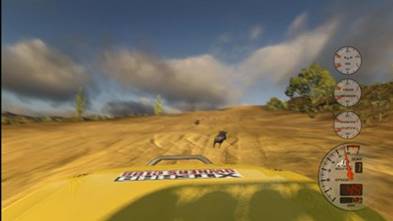
Photo taken from:
http://www.gamesradar.com/xbox360/baja-edge-of-control/preview/the-6-best-moments-in-baja/a-2008061695530793053/g-2008040416735651005/p-2
